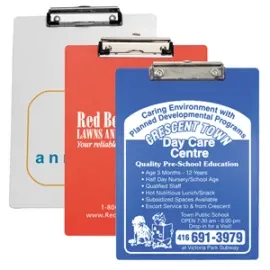
Clipboards remain useful tools in workplaces where employees need to record information, complete forms, inspect equipment, or manage paperwork while moving between locations. From office reception areas to construction sites and delivery operations, the right clipboard can improve organization and make daily tasks easier. Personalized clipboards for business can also help teams maintain a consistent professional appearance while keeping essential documents accessible.
However, not every clipboard suits every work environment. Material, storage capacity, writing surface, portability, and durability should all be considered before making a purchase.
1. Consider Where the Clipboard Will Be Used
The working environment is the first factor to evaluate. Office employees may need lightweight clipboards for registration forms, meeting notes, or routine paperwork. Field teams, on the other hand, may require sturdier products that can withstand frequent handling and changing weather conditions.
For warehouses, inspections, and construction environments, choose clipboards made from durable materials that are easy to clean. For administrative work, a lightweight design with a smooth writing surface may be sufficient.
Understanding how employees will use the clipboard helps narrow down the available options and prevents businesses from paying for features they do not need.
2. Select a Suitable Material
Clipboards are available in plastic, wood, acrylic, metal, and composite materials. Each option has different advantages.
Plastic clipboards are generally lightweight and easy to maintain, making them suitable for everyday office tasks and fieldwork. Wooden clipboards offer a traditional, rigid writing surface, while metal options may provide additional durability for demanding environments.
Consider the conditions in which the clipboard will be used. If employees work outdoors, a material that handles moisture and frequent cleaning may be preferable. For indoor administrative use, appearance and weight may be more important.
The material should balance durability, comfort, and cost without making the clipboard difficult to carry.
3. Check the Clip Strength and Writing Surface
The clip is one of the most important components because it keeps papers securely in place. A weak clip may allow documents to slip, particularly when employees are walking, standing, or working outdoors.
Look for a firm grip, smooth edges, and a mechanism that opens easily without excessive force. The clip should accommodate the typical number of pages employees handle during their work.
The writing surface also matters. A rigid, even board supports handwriting and reduces discomfort when there is no desk available. Rounded corners and a smooth finish can make the product more comfortable to hold throughout the day.
4. Decide Whether Storage Is Necessary
Some employees need only a flat surface for holding documents, while others carry forms, pens, checklists, and small accessories between locations. In these situations, a clipboard with built-in storage may be more practical.
A custom logo storage clipboard can combine document protection, organized storage, and workplace branding. Such designs may suit inspectors, supervisors, technicians, and field representatives who need to keep paperwork and writing tools together.
Before selecting one, check the storage compartment’s capacity, hinge quality, closure mechanism, and overall weight. A compartment that is too small may not accommodate the required forms, while an overly bulky design can become inconvenient to carry.
5. Choose the Right Size and Format
Clipboard size should match the documents employees use most often. Standard paper sizes are suitable for many administrative tasks, while larger formats may be needed for technical drawings, inspection sheets, or specialized forms.
Consider whether employees need portrait or landscape orientation. Some designs also include low-profile clips, handles, or hanging holes that support specific workplace routines.
For teams working in confined spaces, a compact clipboard may be easier to manage. Employees who complete lengthy forms may benefit from a larger writing area.
6. Consider Branding and Customization
Branded clipboards can help businesses maintain a coordinated appearance across departments, events, and field operations. Logos, company colours, and simple identifying details can be incorporated into the design.
Keep branding clear without interfering with the writing surface or the product’s practical function. Before ordering, review the logo artwork, placement, print quality, and available customization methods.
Businesses should also consider whether the clipboard will be used internally, distributed to clients, or provided at trade shows and training sessions. The intended purpose can influence the appropriate design and level of customization.
7. Compare Durability, Quantity, and Budget
The lowest-priced clipboard may not always offer the best long-term value. Frequent use can expose weaknesses in the clip, hinges, surface finish, and storage compartments.
Compare product specifications, expected lifespan, customization costs, and delivery timelines. If ordering for a large team, request samples to evaluate comfort and construction before committing to bulk quantities.
It is also helpful to standardize clipboard types within teams where possible. This can simplify purchasing, replacement, and inventory management.
Conclusion
Choosing clipboards for busy offices and field teams requires balancing durability, portability, storage, writing comfort, and budget. The right design should support employees’ everyday tasks while remaining practical for their working environment. Businesses evaluating advertising promotional products can also consider customized clipboards for workplace use, training sessions, and corporate events. BRAVA Marketing operates in the promotional products and customized merchandise sector, where businesses can explore branded office supplies as part of their broader merchandise requirements.
